
Carrier Nomenclature Breakdown
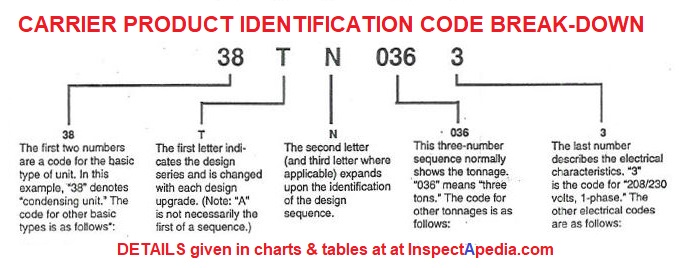
Frequently Asked Questions: Understanding Carrier Model Numbers
Carrier air conditioners and furnaces use a specific naming system for their models. Decoding these model numbers can give you valuable information about the unit's features, efficiency, and series. This FAQ aims to demystify Carrier's naming conventions, helping you understand your HVAC equipment better.
Q1: Why is understanding the Carrier model number important?
Understanding your Carrier unit's model number is crucial for several reasons:
- Identifying Specifications: The model number provides key details about the unit's cooling capacity (BTU), efficiency (SEER/AFUE), and other important specifications.
- Finding Replacement Parts: When you need to repair your unit, knowing the exact model number is essential for ordering the correct replacement parts.
- Warranty Verification: Your unit's model number is required to verify warranty coverage and make claims.
- Comparing Models: If you're considering replacing your unit, understanding model numbers helps you compare different options and choose the best fit for your needs.
- Troubleshooting Issues: Many online resources and HVAC technicians rely on the model number to accurately diagnose and resolve issues.
Q2: What does a typical Carrier model number look like, and what are the basic components?
Carrier model numbers vary slightly depending on the type of equipment (air conditioner, furnace, heat pump), but they generally follow a consistent pattern. Here's a breakdown of the typical components:
- Prefix (Letters): Usually indicates the product family or series (e.g., "24A" for a certain air conditioner series, "59T" for a high-efficiency furnace).
- Capacity (Numbers): Represents the unit's cooling or heating capacity, often in thousands of BTUs (British Thermal Units). For example, "036" might mean 36,000 BTU.
- Efficiency (Letters/Numbers): Denotes the unit's efficiency rating, such as SEER (Seasonal Energy Efficiency Ratio) for air conditioners or AFUE (Annual Fuel Utilization Efficiency) for furnaces. Sometimes this is embedded within other alpha-numeric combinations.
- Series/Features (Letters/Numbers): Provides information about the unit's specific features, technology, and overall series within the Carrier product line. This can be a complex combination of letters and numbers and may be product-specific.
- Revision/Evolution (Numbers): Indicates a specific revision or evolution of the model within its series. This might be a single number or a short code.
Example: Let's take a hypothetical model number: 24ABC036A123
- 24ABC: This is the product family.
- 036: This suggests 36,000 BTU cooling capacity (3 tons).
- A123: This designates a series of features and the revision.
Remember: This is a simplified example, and the exact meaning of each segment can vary. Consult Carrier's official documentation or a qualified HVAC technician for precise interpretation.
Q3: How can I find the model number on my Carrier unit? Where is it typically located?
Finding the model number on your Carrier unit is usually straightforward. It's typically printed on a rating plate or sticker attached to the unit. Here's where to look, depending on the equipment type:
- Air Conditioner (Outdoor Unit): Look on the side or back panel of the outdoor unit. The rating plate is often near the electrical connections.
- Furnace (Indoor Unit): The rating plate is generally located inside the furnace cabinet, often on the blower compartment door or on the side of the unit. Caution: Turn off the power to the furnace before opening the cabinet. If you are not comfortable doing this, contact a qualified HVAC technician.
- Heat Pump (Outdoor Unit): Similar to air conditioners, the rating plate is usually on the side or back panel of the outdoor unit.
- Indoor Air Handler: Check the side of the indoor air handler unit, usually near where the refrigerant lines connect.
The rating plate will typically display the model number, serial number, electrical specifications (voltage, amperage), and other important information. The model number is usually clearly labeled as "Model No." or "Model Number."
Q4: What do the numbers indicating BTU capacity typically mean in the model number (e.g., "024," "036," "048")? How do I convert that to tons?
The numbers in the model number that represent BTU (British Thermal Units) capacity indicate the unit's cooling or heating power. Here's how to interpret them and convert them to tons for air conditioners and heat pumps:
- BTU Capacity Representation: These numbers usually represent the BTU capacity in thousands. For example:
- "024" typically means 24,000 BTU
- "030" typically means 30,000 BTU
- "036" typically means 36,000 BTU
- "042" typically means 42,000 BTU
- "048" typically means 48,000 BTU
- "060" typically means 60,000 BTU
- Converting BTU to Tons: Air conditioning capacity is often expressed in "tons," where 1 ton of cooling equals 12,000 BTU per hour. To convert from BTU to tons, divide the BTU value by 12,000.
- 24,000 BTU / 12,000 BTU/ton = 2 tons
- 36,000 BTU / 12,000 BTU/ton = 3 tons
- 48,000 BTU / 12,000 BTU/ton = 4 tons
- 60,000 BTU / 12,000 BTU/ton = 5 tons
Therefore, if your Carrier air conditioner model number contains "036," it likely indicates a 3-ton unit.
Q5: Can you give some examples of what prefixes might mean in Carrier air conditioner and furnace model numbers (e.g., what does "24A" or "59T" signify in general terms)?
Carrier uses prefixes (the letters at the beginning of the model number) to identify the product family, series, and sometimes specific features of the unit. While a comprehensive list of all prefixes and their meanings is proprietary and not publicly available, here are some general examples to illustrate the concept:
- Air Conditioner Prefixes:
- 24A: Could indicate a specific series of air conditioners, perhaps a performance or efficiency tier. The exact letters after "24" further refine the characteristics of the model.
- 25H: Might denote a high-efficiency air conditioner series with specific features like a variable-speed compressor.
- 38M: Could indicate a more basic, standard-efficiency air conditioner series.
- Furnace Prefixes:
- 58S: Potentially a standard-efficiency furnace series.
- 59T: Often indicates a high-efficiency furnace, possibly with a two-stage or modulating gas valve.
- 48P: May represent a specific series of packaged units.
Important Considerations:
- Manufacturer Specific: These prefixes are specific to Carrier. Other brands use different naming conventions.
- Series and Features: The prefixes often correspond to a particular series of equipment, with each series having a specific set of features, efficiency levels, and technologies.
- Changes Over Time: Carrier may change their naming conventions over time, so older models may use different prefixes.
To determine the exact meaning of a specific prefix, it's best to consult Carrier's official product literature, spec sheets, or contact a Carrier dealer. They can provide you with detailed information about the specific series and features associated with that prefix.
Q6: How do I find the SEER rating for my air conditioner or the AFUE rating for my furnace using the model number? Is it always explicitly included?
Finding the SEER (Seasonal Energy Efficiency Ratio) rating for your air conditioner or the AFUE (Annual Fuel Utilization Efficiency) rating for your furnace using the model number can be tricky. The SEER or AFUE rating is NOT always explicitly included in the model number itself. However, the model number will help you find the correct information.
Here's how to find the efficiency rating:
- Check the Rating Plate: Sometimes, the SEER or AFUE rating is listed directly on the unit's rating plate, along with the model number, serial number, and other specifications. Look for labels such as "SEER:" or "AFUE:".
- Use the Model Number to Search Online:
- Carrier's Website: Go to Carrier's official website and search for your unit using the model number. The product specifications should include the SEER or AFUE rating.
- AHRI Directory: The Air Conditioning, Heating, and Refrigeration Institute (AHRI) maintains a directory of certified HVAC equipment. You can search their database using the model number to find the certified SEER or AFUE rating.
- Online Retailer or HVAC Supply Websites: Many online retailers and HVAC supply companies list product specifications, including SEER and AFUE, alongside the model number.
- Contact a Carrier Dealer: A Carrier dealer can look up the specifications for your unit using the model number and provide you with the SEER or AFUE rating.
Why isn't it always directly in the model number?
- Space Limitations: Model numbers are often designed to be concise, and including the full SEER or AFUE rating would make them too long and cumbersome.
- Variations: The exact SEER rating can vary slightly depending on the specific indoor unit (air handler or furnace) that is paired with the outdoor unit. The model number primarily identifies the outdoor unit.
- Marketing Strategy: Manufacturers sometimes prefer to highlight the efficiency rating separately in marketing materials rather than embedding it directly in the model number.
Q7: What does it mean if there are additional letters or numbers at the end of the model number? Do these signify anything important for homeowners?
Additional letters or numbers at the end of the Carrier model number often indicate specific variations, revisions, or features within the same basic model series. While the exact meaning can vary widely, they often relate to manufacturing details, software updates, or compatibility with certain accessories. These suffixes are important for technicians and parts suppliers to select the correct replacement components.
Here are some potential meanings:
- Revision Levels: A number at the end might indicate a specific revision or version of the model. This could reflect minor design changes, software updates, or improvements made during the production run.
- Specific Features or Options: Letters might designate specific options or features included with the unit, such as a particular type of control system, a different fan motor, or a special coating on the coils.
- Manufacturing Location: In some cases, these codes can indicate the manufacturing plant where the unit was assembled.
- Paint Color or Finish: These may refer to color variations.
Why are these suffixes important?
- Replacement Parts: While the core components may be the same across a model series, the specific parts used in different revisions or with different options can vary. Using the wrong replacement part can lead to compatibility issues or improper operation.
- Troubleshooting: Some troubleshooting procedures or service bulletins may be specific to certain model number suffixes. Technicians need to be aware of these differences to accurately diagnose and resolve issues.
- Warranty: In rare cases, the warranty coverage or terms might vary slightly depending on the model number suffix.
For Homeowners and Facility Managers: While the additional letters and numbers at the end of the model number might seem insignificant, they are crucial for ensuring you get the correct parts, service, and information for your specific unit. Always provide the full model number, including the suffix, when contacting a technician, ordering parts, or seeking warranty support.


