Cfm For 6 Inch Round Duct

Understanding airflow is critical for efficient heating, ventilation, and air conditioning (HVAC) systems. One key measurement of airflow is CFM, or cubic feet per minute. This metric quantifies the volume of air moving through your ductwork, impacting everything from comfort levels to energy bills. This article will explore the specifics of CFM requirements for a 6-inch round duct, providing valuable information for homeowners, HVAC technicians, and facility managers alike.
What is CFM and Why Does it Matter?
CFM (cubic feet per minute) measures the volume of air flowing past a fixed point in one minute. Imagine a 1-foot by 1-foot by 1-foot box. If you move one box-worth of air past a specific location every minute, that's 1 CFM. In HVAC systems, CFM dictates how effectively conditioned air is distributed throughout a building. Insufficient CFM can lead to:
- Uneven heating and cooling: Rooms furthest from the HVAC unit may be significantly warmer or cooler than those nearby.
- System inefficiency: The HVAC unit has to work harder and longer to achieve the desired temperature, consuming more energy.
- Equipment damage: Overworked HVAC equipment can experience premature wear and tear, shortening its lifespan.
- Poor air quality: Inadequate ventilation can lead to a buildup of pollutants and allergens, negatively impacting indoor air quality.
Conversely, excessive CFM can also be problematic, resulting in:
- Drafts and noise: High airflow velocities can create uncomfortable drafts and generate excessive noise.
- Energy waste: Overly aggressive airflow can overcool or overheat spaces, leading to wasted energy.
- Increased static pressure: High airflow through undersized ductwork increases static pressure, potentially damaging the blower motor.
CFM Calculation for a 6-Inch Round Duct: Factors at Play
Determining the appropriate CFM for a 6-inch round duct isn't a simple, one-size-fits-all calculation. Several factors influence the ideal CFM, including:
Duct Velocity
Duct velocity, measured in feet per minute (FPM), is the speed at which air travels through the duct. Recommended duct velocities vary depending on the application:
- Main Supply Ducts: 700-900 FPM
- Branch Runs (to individual registers): 500-700 FPM
- Return Air Ducts: 400-600 FPM
Higher velocities can increase noise, while lower velocities may result in inadequate airflow. A commonly used target velocity for residential branch runs is around 600 FPM.
Static Pressure
Static pressure is the resistance to airflow within the ductwork. High static pressure reduces airflow, while low static pressure may indicate leaks or oversized ducts. The HVAC system's blower is designed to overcome static pressure. Most residential systems are designed to operate within a specific static pressure range, typically between 0.5 and 0.8 inches of water column (in. w.c.). Static pressure is measured with a manometer. Using the wrong size or type of duct can significantly impact static pressure, affecting overall system performance.
Duct Material and Construction
The material and construction of the ductwork also impact airflow. Smooth, rigid metal ducts offer the least resistance, while flexible ducts have higher friction losses due to their corrugated interior. Well-sealed ductwork minimizes air leakage, ensuring that the intended CFM reaches its destination.
Duct Length and Fittings
Longer duct runs and numerous fittings (elbows, tees, reducers) increase resistance to airflow. Each fitting adds to the equivalent length of the duct, requiring a higher initial CFM to compensate for the pressure drop. The duct design must account for the total equivalent length to deliver the necessary CFM to each room.
Calculating CFM for a 6-Inch Round Duct: The Formula
The fundamental formula for calculating CFM based on duct velocity and area is:
CFM = Velocity (FPM) x Area (square feet)
First, we need to calculate the area of a 6-inch round duct:
- Radius (r) = Diameter / 2 = 6 inches / 2 = 3 inches = 0.25 feet
- Area (A) = π * r² = 3.14159 * (0.25 feet)² ≈ 0.196 square feet
Now, we can calculate the CFM for different velocities:
- At 600 FPM: CFM = 600 FPM * 0.196 sq ft ≈ 117.6 CFM
- At 700 FPM: CFM = 700 FPM * 0.196 sq ft ≈ 137.2 CFM
- At 800 FPM: CFM = 800 FPM * 0.196 sq ft ≈ 156.8 CFM
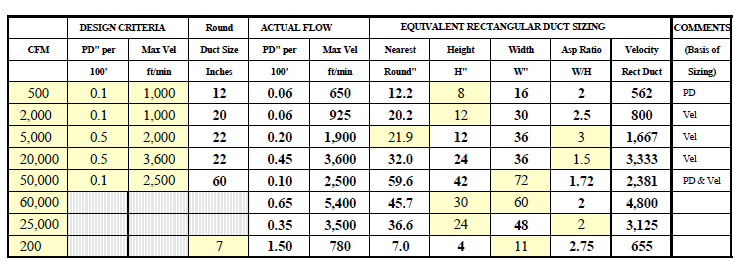
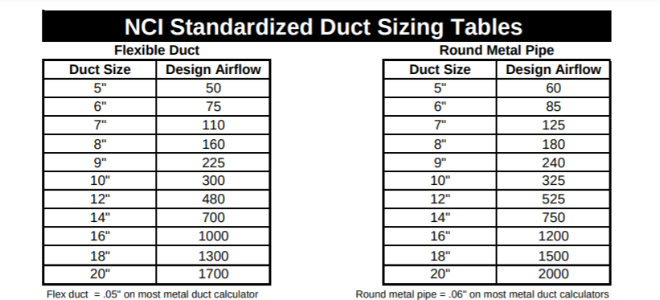
Therefore, a 6-inch round duct can typically handle between 117.6 CFM and 156.8 CFM, depending on the desired duct velocity. In residential applications, targeting around 120-140 CFM is often appropriate for a single room or zone.
Practical Applications and Examples
Let's consider a few real-world scenarios:
Scenario 1: Home Addition
A homeowner is adding a 200-square-foot bedroom to their home. The general rule of thumb is to provide 1 CFM per square foot of living space. Therefore, the bedroom requires approximately 200 CFM. Using a single 6-inch duct might be insufficient. It may be necessary to either increase the duct size or install a second 6-inch duct to adequately condition the new space.
Scenario 2: Replacing Existing Ductwork
An HVAC technician is replacing old, leaky ductwork in a home. The existing system has a 6-inch round duct supplying air to a living room. Before replacing the duct, the technician should verify that the duct size is adequate for the room's heating and cooling load. Performing a Manual D calculation (a standard industry method for sizing ductwork) will ensure the correct duct size is used, optimizing system performance.
Scenario 3: Commercial Building Zone
A facility manager is balancing the HVAC system in a commercial building. A zone served by a 6-inch round duct is consistently too warm. The manager should measure the airflow at the register to determine the actual CFM. If the CFM is significantly below the design requirement, the ductwork may be undersized, or there could be obstructions in the duct. Addressing these issues will help to improve the zone's comfort and energy efficiency.
Tools and Techniques for Measuring CFM
Accurately measuring CFM is crucial for diagnosing HVAC system problems and ensuring optimal performance. Several tools can be used for this purpose:
- Anemometer: Measures air velocity at a specific point. By measuring the velocity at multiple points across the duct opening and averaging the results, you can calculate the average velocity and then use the CFM formula.
- Balometer (Flow Hood): Placed over a supply or return register, a balometer directly measures the CFM flowing through the register. This is a more accurate method than using an anemometer, especially for registers with complex designs.
- Manometer: Measures static pressure in the ductwork. Monitoring static pressure can help identify ductwork restrictions or leaks.
Cost Considerations
The cost of installing or replacing ductwork varies depending on the duct material, size, and complexity of the installation. Flexible ducts are generally less expensive than rigid metal ducts but have higher friction losses. Properly sizing and installing ductwork is an investment that can pay off in the long run through improved energy efficiency and reduced maintenance costs. Remember to factor in the cost of sealing the ducts to minimize air leakage, which can significantly improve overall system performance.
Maintenance and Troubleshooting
Regular maintenance is essential for keeping your ductwork in good condition. Periodically inspect the ducts for leaks, damage, or obstructions. Seal any leaks with duct mastic or metal tape (never use duct tape, as it dries out and fails over time). Clean the ducts every few years to remove dust and debris that can restrict airflow and reduce air quality. If you experience uneven heating or cooling, or if your energy bills are higher than usual, it's a good idea to have your HVAC system inspected by a qualified technician. Addressing problems early can prevent more costly repairs down the road.
Conclusion
Understanding the relationship between CFM and duct size is vital for designing, installing, and maintaining efficient HVAC systems. For a 6-inch round duct, the ideal CFM typically falls between 120 and 140 CFM, but this can vary depending on duct velocity, static pressure, and other factors. By carefully considering these factors and using appropriate measurement tools, homeowners, HVAC technicians, and facility managers can ensure that their HVAC systems deliver optimal comfort and energy efficiency. Consulting with a qualified HVAC professional is always recommended to ensure proper duct sizing and system performance. Proper duct design and installation are fundamental to overall HVAC system effectiveness and long-term cost savings. Ignoring these factors can result in poor comfort, higher energy bills, and premature equipment failure. Prioritizing proper airflow management is a smart investment in your home or building's comfort, efficiency, and longevity.