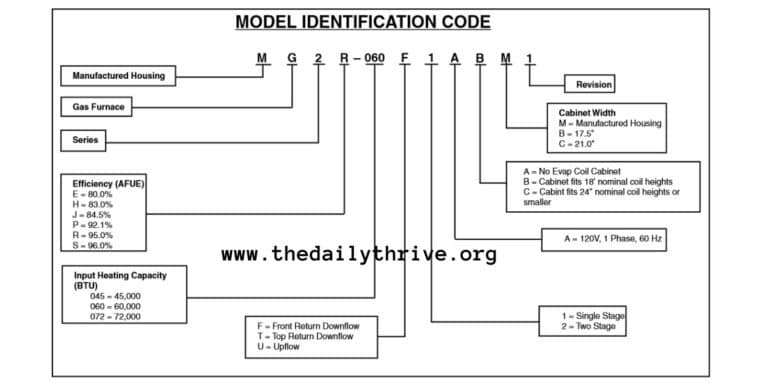
Day And Night Model Number Nomenclature

Decoding Day & Night Model Numbers: A Comprehensive Guide
Understanding the model number nomenclature of your HVAC equipment can be a daunting task, even for seasoned professionals. However, demystifying these alphanumeric codes provides invaluable insights into the system's capabilities, efficiency, and intended application. This article focuses on Day & Night HVAC systems, breaking down their model number structures to empower homeowners, technicians, and facility managers alike.
General Structure of Day & Night Model Numbers
Day & Night, a brand under the Carrier Global Corporation umbrella, generally follows a consistent pattern in their model numbers. While slight variations may exist across product lines (furnaces, air conditioners, heat pumps), the core components remain relatively stable. A typical model number will include sections designating the product type, efficiency rating, tonnage (cooling capacity), series, and specific features or revisions. Let's examine each of these components in detail.
1. Product Type
The initial characters often signify the type of HVAC equipment. Common codes include:
- G8: Indicates a gas furnace.
- C4: Signifies an air conditioner.
- N4: Denotes a heat pump.
These prefixes provide a quick identification of the unit's primary function. For instance, a model number starting with "G8" is undoubtedly a gas furnace, while "C4" indicates an air conditioning unit.
2. Efficiency Rating
Following the product type, digits frequently denote the efficiency rating. For furnaces, this is usually the Annual Fuel Utilization Efficiency (AFUE), expressed as a percentage. For air conditioners and heat pumps, this usually references Seasonal Energy Efficiency Ratio (SEER) or Heating Seasonal Performance Factor (HSPF). For example:
- G8M050: The "050" often (though not always directly) correlates to a furnace with an AFUE around 80% (although in modern high-efficiency furnaces, the numbers might need further decoding specific to the series).
- C4A336: The "336" might indicate a SEER value derived from those numbers (though not directly). Determining the SEER requires referring to the manufacturer’s official documentation or AHRI directory, and is also often related to tonnage.
It's important to note that these numbers may not directly translate to the exact efficiency rating. It's crucial to consult the product specifications or the AHRI (Air-Conditioning, Heating, and Refrigeration Institute) directory to confirm the actual SEER, AFUE, or HSPF rating. AHRI provides certified performance data for HVAC equipment, ensuring accurate comparisons.
3. Tonnage (Cooling Capacity)
For air conditioners and heat pumps, a key component of the model number represents the cooling capacity, expressed in tons. One ton is equivalent to 12,000 BTU/h (British Thermal Units per hour). The tonnage is typically represented by two or three digits.
- C4A336: The "36" represents 36,000 BTU/h, or a 3-ton unit.
- N4H448: The "48" represents 48,000 BTU/h, or a 4-ton unit.
Properly sizing your air conditioner or heat pump is crucial for optimal performance and efficiency. An undersized unit will struggle to cool the space adequately, while an oversized unit can lead to short cycling, humidity problems, and reduced energy efficiency.
4. Series Designation
The series designation indicates the product line within Day & Night's portfolio. Different series often feature varying levels of technology, performance, and features. Look for letters in the model number that correspond to the series, examples include:
- C4A3: This indicates a specific series, often associated with a certain level of features or efficiency.
- G8M0: This indicates a specific series, often associated with a certain level of features or efficiency.
Understanding the series helps you compare features and benefits across different models. Premium series often incorporate advanced technologies such as variable-speed blowers, communicating controls, and enhanced sound dampening.
5. Additional Features and Revisions
The final characters in the model number may represent specific features, revisions, or variations within the same model line. These codes are often specific to the manufacturer and may require consulting the product documentation or contacting Day & Night directly for clarification.
Real-World Examples and Applications
Let's consider a few real-world examples to illustrate how to decipher Day & Night model numbers:
Example 1: G8M0801002120
- G8: Gas furnace
- M080: Indicates an AFUE around 80% (Consult AHRI directory for exact value).
- 100: Suggests a heating capacity of 100,000 BTU/h.
- 21: Indicates a specific blower motor type or revision level.
- 20: Indicates the width of the furnace in inches, which can be helpful for installation.
This model number identifies an 80% AFUE gas furnace with a heating capacity of 100,000 BTU/h, suitable for larger homes in colder climates.
Example 2: C4A336A360
- C4: Air conditioner
- A3: Indicates a specific series with a certain SEER range.
- 36: 36,000 BTU/h cooling capacity (3 tons).
- A360: Might denote a specific voltage requirement or unit revision.
This model represents a 3-ton air conditioner from a specific Day & Night series, indicating its cooling capacity and potential feature set.
Using Model Numbers for Maintenance and Troubleshooting
Understanding model numbers is not just for initial system selection; it's equally crucial for maintenance and troubleshooting. When ordering replacement parts, the model number ensures you receive the correct components compatible with your specific unit. Technicians use model numbers to access technical documentation, wiring diagrams, and troubleshooting guides specific to that model. This facilitates accurate diagnosis and repair, minimizing downtime and ensuring optimal system performance.
AHRI Directory: Your Go-To Resource
As mentioned earlier, the AHRI directory is an invaluable resource for verifying HVAC equipment performance claims. By entering the full model number into the AHRI directory, you can access certified SEER, AFUE, HSPF, and cooling capacity ratings. This independent verification ensures transparency and allows you to make informed decisions based on accurate data. The AHRI directory can be accessed on the AHRI website (www.ahridirectory.org).
Cost, Efficiency, and Lifespan Considerations
The model number, once decoded, allows for informed comparisons of cost, efficiency, and lifespan across different Day & Night systems. Higher efficiency models (e.g., those with higher SEER or AFUE ratings) typically have a higher upfront cost, but they offer significant long-term savings on energy bills. The series designation can also influence the price, with premium series generally commanding a higher premium due to their advanced features and enhanced performance. Properly maintained HVAC systems typically last 15-20 years, but lifespan can be significantly impacted by factors such as usage patterns, environmental conditions, and the quality of maintenance.
Conclusion
Decoding Day & Night model numbers empowers homeowners, technicians, and facility managers to make informed decisions about HVAC equipment selection, maintenance, and troubleshooting. By understanding the components of the model number, you can gain valuable insights into the system's capabilities, efficiency, and intended application. Remember to consult the AHRI directory for certified performance data and to work with qualified HVAC professionals for proper installation and maintenance.