Ft Of Head To Psi Calculator

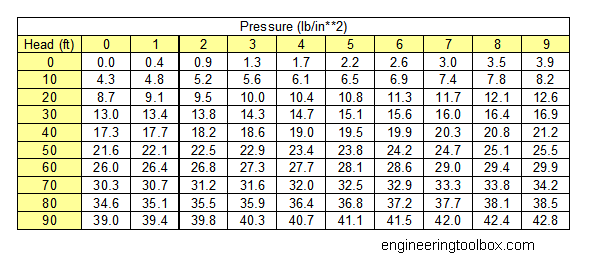
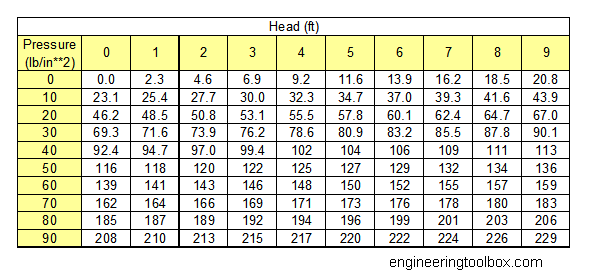
Understanding the relationship between feet of head and PSI (pounds per square inch) is crucial in various fields, including plumbing, hydraulics, HVAC (Heating, Ventilation, and Air Conditioning), and even certain aspects of engineering. While they measure pressure, they do so using different units. This article will break down the concept, explain how to convert between them, and provide practical examples to help you grasp the fundamentals.
What are Feet of Head and PSI?
Before diving into the conversion, it's essential to define each unit:
Feet of Head
Feet of head is a measure of pressure expressed as the height of a column of fluid that a pump can lift. It's commonly used in pump specifications to describe the pump's ability to overcome resistance and deliver fluid to a certain elevation. Think of it this way: if a pump has a head of 10 feet, it can theoretically push water 10 feet straight up (neglecting friction and other losses).
The key here is that the "head" is *relative* to the density of the fluid being pumped. The same pump will have a different feet of head rating if pumping water versus a denser fluid like oil. It tells you about the *energy* the pump imparts to the fluid, which then translates to a height.
PSI (Pounds per Square Inch)
PSI (pounds per square inch) is a more direct measurement of pressure. It represents the force exerted on a surface area of one square inch. PSI is a common unit in many applications, from tire pressure to hydraulic systems. It directly reflects the force concentrated on a given area.
Imagine placing a one-pound weight on a one-square-inch surface. That surface is experiencing 1 PSI of pressure.
The Conversion Formula: Feet of Head to PSI
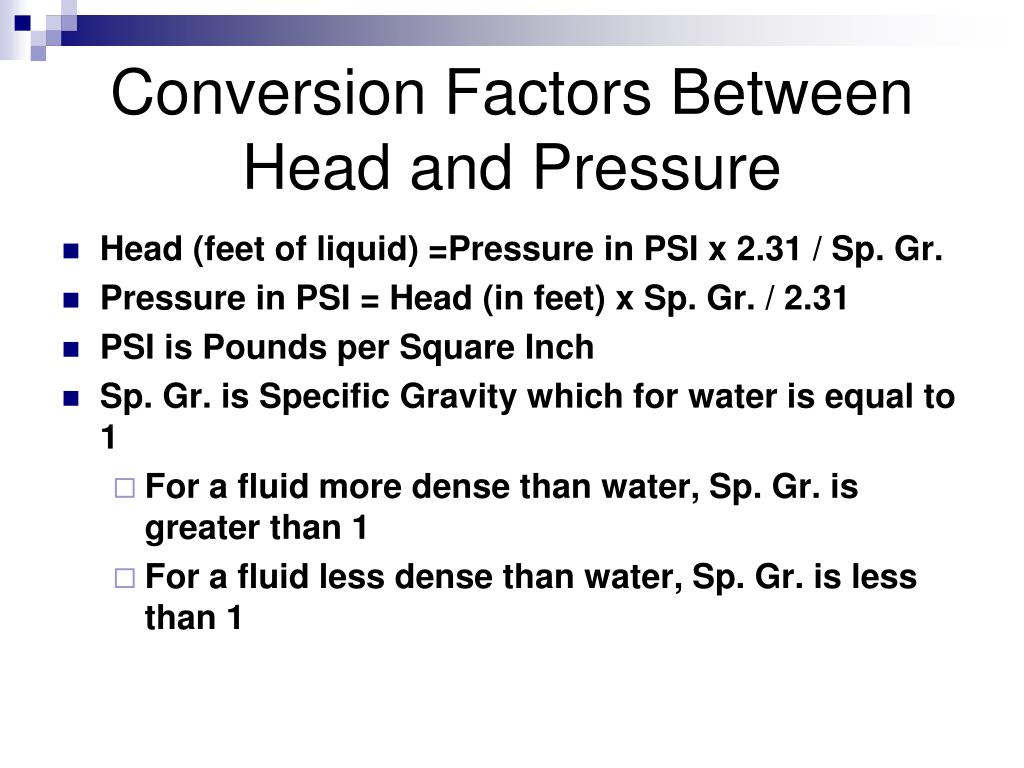
The conversion between feet of head and PSI relies on the density of the fluid. The formula is as follows:
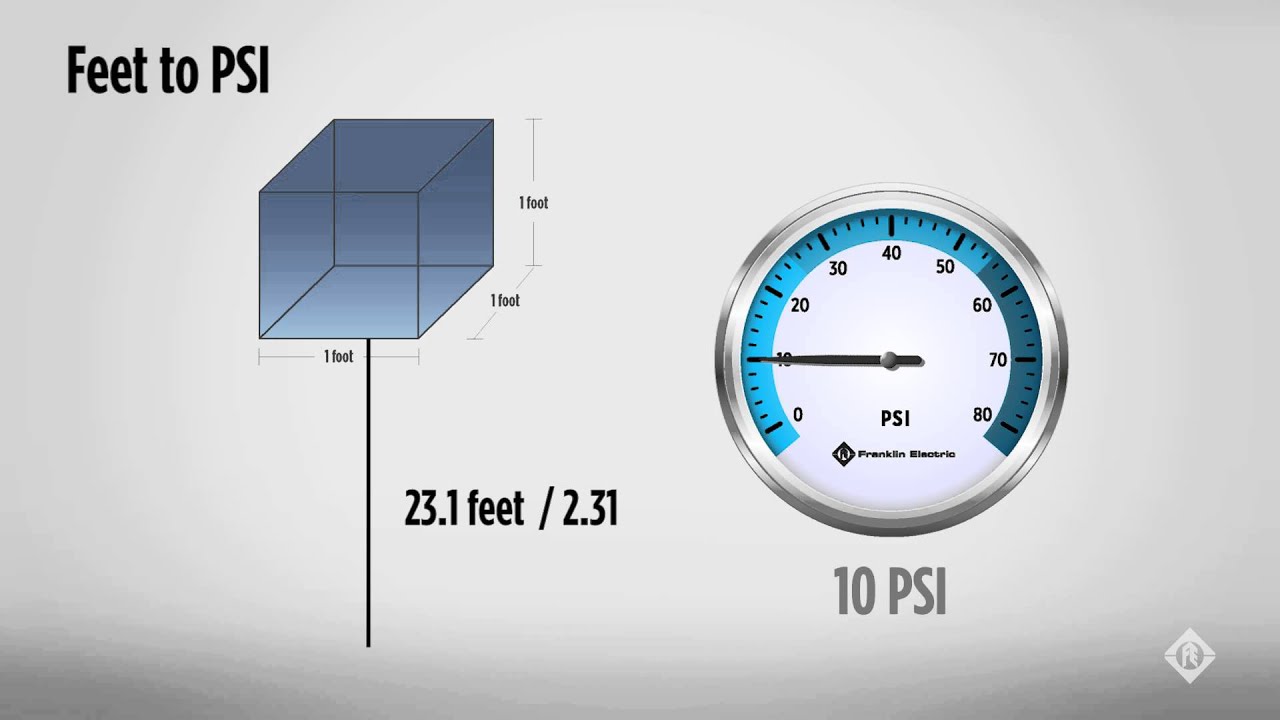
PSI = (Feet of Head * Density of Fluid) / 144
Where:
- PSI is the pressure in pounds per square inch.
- Feet of Head is the pressure expressed as the height of a fluid column.
- Density of Fluid is the weight of the fluid per unit volume, typically in pounds per cubic foot (lbs/ft³).
- 144 is a conversion factor (1 ft² = 144 in²). It's needed to ensure the units align correctly, since we're converting from feet (in feet of head) to inches (in PSI, pounds per *square inch*).
Important Consideration: Always make sure you have the correct density value for the specific fluid you're working with. Using the wrong density will lead to inaccurate conversions.
Density of Common Fluids
Here are the densities of some common fluids at standard temperatures, which you'll need for the conversion:
- Water (at 60°F): Approximately 62.4 lbs/ft³
- Seawater: Approximately 64 lbs/ft³ (slightly denser than freshwater due to salt content)
- Oil (varies depending on type): Varies widely, but a typical value might be around 55 lbs/ft³
- Glycol (varies by concentration): Ranges from 62.4 lbs/ft³ to 70 lbs/ft³ (or more) depending on the concentration of glycol in water.
Note: Fluid density changes with temperature. For precise calculations, always consult density charts specific to the fluid and temperature you're working with.
Example Calculations: Feet of Head to PSI
Let's work through a few examples to illustrate the conversion process:
Example 1: Water
Problem: A pump has a head of 50 feet of water. What is the equivalent pressure in PSI?
Solution:
- Identify the knowns: Feet of Head = 50 ft, Density of Water (at 60°F) = 62.4 lbs/ft³
- Apply the formula: PSI = (50 ft * 62.4 lbs/ft³) / 144
- Calculate: PSI = 3120 / 144 = 21.67 PSI (approximately)
Answer: 50 feet of head of water is approximately equivalent to 21.67 PSI.
Example 2: Seawater
Problem: A pump has a head of 100 feet of seawater. What is the equivalent pressure in PSI?
Solution:
- Identify the knowns: Feet of Head = 100 ft, Density of Seawater = 64 lbs/ft³
- Apply the formula: PSI = (100 ft * 64 lbs/ft³) / 144
- Calculate: PSI = 6400 / 144 = 44.44 PSI (approximately)
Answer: 100 feet of head of seawater is approximately equivalent to 44.44 PSI.
Example 3: Glycol Solution
Problem: A closed loop hydronic system uses a 50/50 glycol solution with a density of 65 lbs/ft³. If a pressure gauge reads 30 feet of head, what is the pressure in PSI?
Solution:
- Identify the knowns: Feet of Head = 30 ft, Density of Glycol Solution = 65 lbs/ft³
- Apply the formula: PSI = (30 ft * 65 lbs/ft³) / 144
- Calculate: PSI = 1950 / 144 = 13.54 PSI (approximately)
Answer: 30 feet of head of this glycol solution is approximately equivalent to 13.54 PSI.
Practical Applications and Considerations
Understanding the conversion between feet of head and PSI is vital in various situations:
- Pump Selection: When selecting a pump, manufacturers often provide performance curves in terms of feet of head. Converting to PSI allows you to determine if the pump can deliver the required pressure for your specific application. For example, if you need to maintain a certain pressure at a sprinkler head, you'll need to choose a pump that can provide the equivalent feet of head at the desired flow rate.
- System Design: In hydraulic systems, understanding pressure losses due to pipe friction is critical. Friction losses are often expressed as feet of head loss per 100 feet of pipe. Converting this loss to PSI allows for accurate pressure drop calculations across the entire system.
- Troubleshooting: If a system is not performing as expected, converting between feet of head and PSI can help diagnose the problem. For instance, a low pressure reading in PSI might indicate a problem with the pump's head capacity.
- HVAC Systems: In hydronic heating and cooling systems, understanding the relationship between feet of head and PSI is crucial for properly sizing pumps and ensuring adequate water circulation. The expansion tank pressure is often described in feet of head to determine the correct location within the system.
Beyond the Formula: System Curves and Total Dynamic Head (TDH)
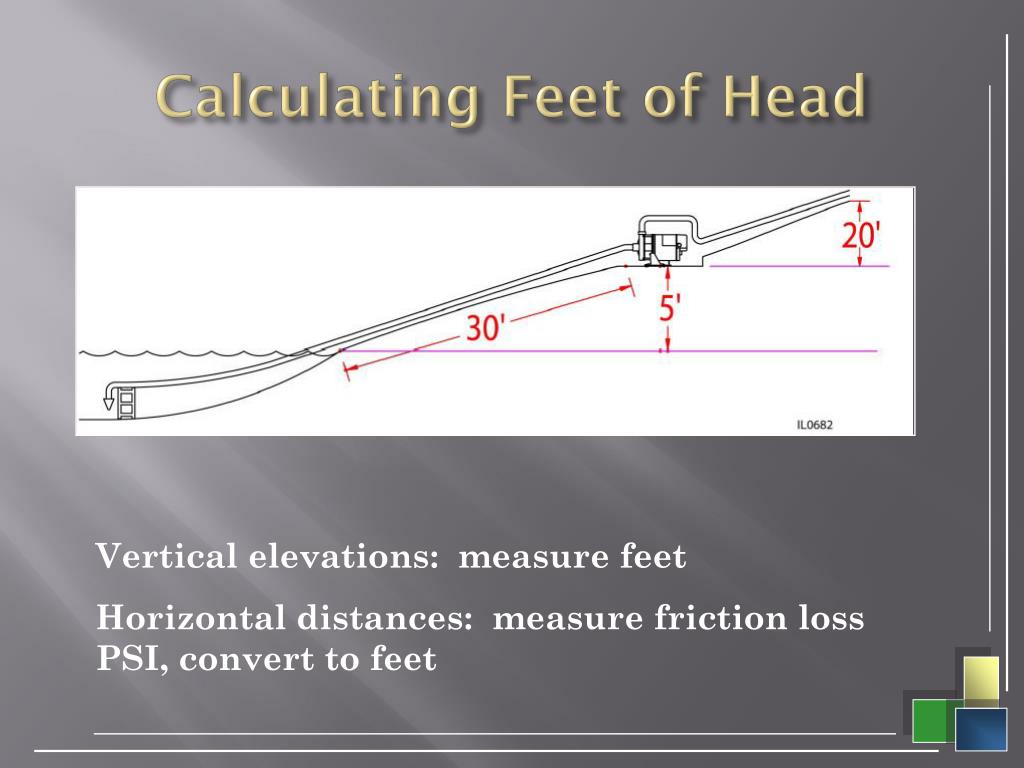
While the formula provides a direct conversion, real-world systems are more complex. Total Dynamic Head (TDH) represents the total resistance a pump must overcome. This includes static head (elevation difference), pressure head, and friction losses. System curves illustrate the relationship between flow rate and head for a particular piping system. Proper pump selection involves matching the pump's performance curve to the system curve to ensure the desired flow and pressure are achieved.
Safety Note: Always consult with a qualified professional when dealing with pressurized systems, especially those involving potentially hazardous fluids. Improperly sized or operated systems can lead to equipment damage or personal injury.
Online Calculators and Tools
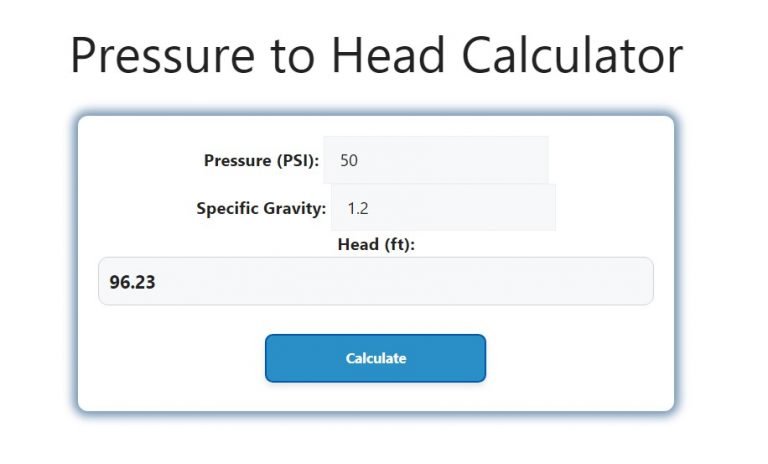
Several online calculators are available to simplify the conversion process. These tools can be particularly useful for quick calculations or when dealing with complex fluids. However, it's always a good idea to understand the underlying principles and verify the results with manual calculations, especially in critical applications.
Conclusion
Converting between feet of head and PSI is a fundamental skill for anyone working with fluid systems. By understanding the relationship between these units and the importance of fluid density, you can accurately calculate pressure requirements, select appropriate equipment, and troubleshoot system problems effectively. Remember to consider the specific fluid you're working with, account for temperature variations, and consult with professionals when necessary to ensure safe and reliable system operation. Accurate conversions and a clear understanding of these concepts are essential for successful design, operation, and maintenance of fluid handling systems.