How Big Is My Ac Unit
Determining the right size air conditioning (AC) unit for your home is crucial for comfort, efficiency, and cost savings. An AC that's too small won't adequately cool your space, leading to discomfort and overworking the unit. An AC that's too large will cycle on and off too frequently, resulting in temperature swings, higher energy bills, and potential damage to the system.
This guide will walk you through the process of figuring out the appropriate AC unit size for your needs. We'll cover the factors involved, the measurement methods, and what to consider before making a purchase.
Understanding AC Unit Sizing: BTUs and Tonnage
The size of an AC unit is typically measured in two units: British Thermal Units (BTUs) and tons. Understanding these terms is essential for making an informed decision.
What are BTUs?
A BTU is a unit of energy that measures the amount of heat required to raise the temperature of one pound of water by one degree Fahrenheit. In the context of AC units, BTUs represent the amount of heat the unit can remove from a room in one hour. The higher the BTU rating, the more cooling power the unit has.
For example, a 5,000 BTU AC unit can remove 5,000 BTUs of heat per hour.
What is Tonnage?
A ton of cooling is equivalent to 12,000 BTUs per hour. This term originally referred to the amount of heat needed to melt one ton of ice in 24 hours. While we're not melting ice, the "ton" measurement is still used as a shorthand for larger AC systems, particularly for whole-house cooling.
Therefore, a 1-ton AC unit has a cooling capacity of 12,000 BTUs, a 2-ton unit has a cooling capacity of 24,000 BTUs, and so on.
Factors Influencing AC Unit Size
Several factors contribute to determining the ideal AC unit size for your home. It's not just about the square footage of the space. These factors include:
- Square Footage: The most basic factor. Larger spaces require more cooling power.
- Climate: Regions with hotter summers demand more powerful AC units.
- Insulation: Good insulation keeps heat out in the summer and in during the winter, reducing the load on your AC.
- Windows: The number, size, and type of windows significantly impact heat gain. Windows let in sunlight and heat.
- Ceiling Height: Higher ceilings mean more volume to cool.
- Number of Occupants: More people generate more body heat.
- Sun Exposure: Rooms with significant sun exposure require more cooling.
- Appliances: Heat-generating appliances like ovens, computers, and dryers add to the cooling load.
- Ductwork (for central AC): Leaky or poorly designed ductwork reduces efficiency.
Methods for Determining AC Unit Size
There are several methods you can use to estimate the appropriate AC unit size for your home. These range from simple rules of thumb to more detailed calculations.
The Square Footage Rule of Thumb
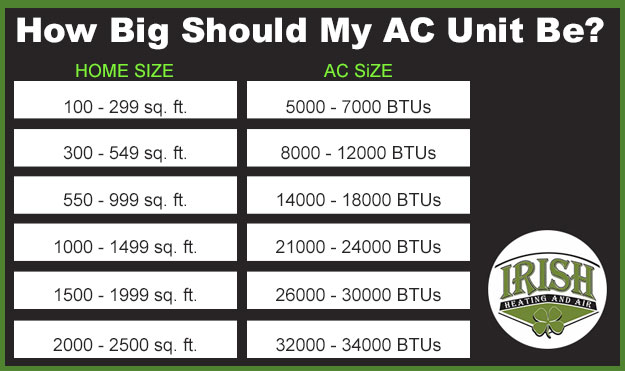
A common rule of thumb is to use 20 BTUs per square foot. This is a very rough estimate, but it can give you a starting point. To calculate the required BTU rating, multiply the square footage of the area you want to cool by 20. This is useful for a single room, but not for a whole house.
Example: A 500 square foot room would need approximately 10,000 BTUs (500 x 20 = 10,000).
Important Note: This method is a *very general* guideline. It doesn't account for the other factors listed above, so it should only be used as a preliminary estimate.
Manual J Calculation: The Professional Approach
The most accurate way to determine the correct AC unit size is to perform a Manual J calculation. This is a detailed load calculation that takes into account *all* the factors mentioned earlier, including insulation levels, window types, climate data, and occupancy.
Manual J calculations are typically performed by HVAC professionals using specialized software. They involve a thorough assessment of your home's characteristics and energy efficiency. While it's more expensive than the rule-of-thumb method, it provides the most reliable result and can save you money in the long run by preventing over- or under-sizing your AC unit.
Think of it this way: Using the square footage rule of thumb is like guessing your weight. A Manual J calculation is like stepping on a scale – you get a precise measurement.
Online AC Sizing Calculators
Several online AC sizing calculators are available. These calculators are more sophisticated than the square footage rule of thumb but less comprehensive than a Manual J calculation. They typically ask for information about your home's size, climate, insulation, and window types.
While these calculators can provide a more accurate estimate than the square footage rule, it's still crucial to consider that they are based on general assumptions and may not fully account for all the specific characteristics of your home.
Caution: Treat these calculators as a guide, not a definitive answer. It's always best to consult with an HVAC professional for a more accurate assessment.
Steps to Determine Your AC Unit Size (DIY Approach)
If you're comfortable doing some research and gathering information, you can take a more hands-on approach to estimating your AC unit size. Here's a step-by-step guide:
- Measure the Square Footage: Calculate the square footage of the area you want to cool. For a single room, simply multiply the length by the width. For a whole house, add up the square footage of all the rooms you want to cool.
- Assess Your Climate Zone: Determine your climate zone based on your location. Climate zones are often categorized by heating and cooling degree days, which reflect the average temperature differences from a baseline temperature (usually 65°F). You can find your climate zone information online through resources like the Department of Energy or local weather websites.
- Evaluate Your Insulation: Check your home's insulation levels. Look for insulation in your attic, walls, and crawl spaces. If you have older insulation, it may not be as effective as newer materials. Insufficient insulation can drastically increase the cooling load.
- Count and Assess Your Windows: Count the number of windows and note their size and type (e.g., single-pane, double-pane, low-E glass). Windows with direct sunlight exposure will contribute more to heat gain.
- Consider Ceiling Height: If your ceilings are higher than the standard 8 feet, you'll need to factor that into your calculations. Higher ceilings increase the volume of air that needs to be cooled.
- Account for Occupancy and Appliances: Estimate the number of people who will regularly occupy the space and the number of heat-generating appliances (e.g., computers, ovens, dryers).
- Use an Online Calculator (with Caution): Input the information you've gathered into an online AC sizing calculator. Be aware of its limitations.
- Adjust for Specific Conditions: Based on your assessment, make adjustments to the calculator's output. For example, if you have poor insulation, add 10-15% to the recommended BTU rating. If you have a lot of shade, you can subtract 5-10%.
Common Mistakes to Avoid When Sizing Your AC Unit
It's easy to make mistakes when sizing your AC unit. Here are some common pitfalls to avoid:
- Oversizing: Installing an AC unit that's too large is a common mistake. While it might seem like more cooling power is always better, an oversized unit will cycle on and off too frequently. This short-cycling can lead to temperature fluctuations, increased energy bills, and reduced equipment lifespan. It also won't dehumidify properly.
- Undersizing: An AC unit that's too small won't be able to adequately cool your space, especially during peak heat. It will run constantly, consuming more energy and potentially leading to premature failure.
- Ignoring Insulation: Failing to consider the impact of insulation can lead to inaccurate sizing. Good insulation reduces the cooling load, while poor insulation increases it.
- Relying Solely on Square Footage: As mentioned earlier, square footage is only one factor. Ignoring other important considerations can result in an improperly sized unit.
- Not Considering Ductwork (for Central AC): Leaky or poorly designed ductwork can significantly reduce the efficiency of a central AC system. If your ductwork is inefficient, you may need a larger unit to compensate, but fixing the ductwork is often a better long-term solution.
Getting Professional Help
While you can estimate your AC unit size using the methods described above, the best way to ensure accuracy is to consult with a qualified HVAC professional. They can perform a Manual J calculation, assess your home's specific characteristics, and recommend the appropriate AC unit size for your needs.
A professional can also help you choose the right type of AC unit for your home, such as a central AC system, a ductless mini-split system, or window units.
Final Thoughts
Choosing the right size AC unit is an investment in your comfort, energy efficiency, and the longevity of your equipment. By understanding the factors involved, using appropriate measurement methods, and avoiding common mistakes, you can make an informed decision and enjoy a cool and comfortable home for years to come. Don't hesitate to seek professional advice to ensure you get it right. Remember that accuracy is key to optimal performance and cost savings.