How To Calculate Pipe Size For Gas
Frequently Asked Questions: Calculating Pipe Size for Gas
Ensuring you have the correct pipe size for your gas system is critical for safe and efficient operation. Undersized pipes can lead to appliance malfunction, reduced performance, and potentially dangerous situations. This FAQ addresses common questions to help you understand the basics of gas pipe sizing.
Q1: Why is it important to calculate gas pipe size? Can't I just use the same size as the old pipe?
It's tempting to reuse the existing pipe size, but it's generally not recommended without careful consideration. Here's why calculating the correct size is crucial:
- Appliance Demand: New appliances may have higher gas demand than older ones. Using the old pipe size might not supply enough gas, leading to appliance malfunction, reduced performance (e.g., weak flame on a stove), and potential damage.
- System Expansion: If you're adding new appliances to your gas system, you definitely need to recalculate the pipe size. The existing piping might not be adequate for the increased load.
- Code Compliance: Building codes often specify minimum pipe sizes based on appliance demand and pipe length. Using an undersized pipe can lead to code violations and safety hazards.
- Safety: Most importantly, incorrect pipe sizing can lead to dangerous situations, including gas leaks and carbon monoxide buildup if appliances don't burn fuel completely.
In summary, always calculate the required pipe size based on current appliance needs and local building codes, rather than assuming the old pipe size is sufficient.
Q2: What information do I need to calculate the correct gas pipe size?
To accurately calculate gas pipe size, you'll need the following information:
- Appliance Gas Consumption (BTU/hr): This is the most important factor. Each appliance has a specific gas consumption rate, usually expressed in British Thermal Units per hour (BTU/hr). This information is typically found on the appliance's nameplate or in the manufacturer's specifications. Make a list of all gas appliances that will be connected to the system, including furnaces, water heaters, stoves, dryers, fireplaces, and any outdoor appliances.
- Pipe Length: Measure the total length of pipe from the gas meter to each appliance. This includes all straight sections and fittings (elbows, tees, etc.). For fittings, you'll need to estimate their equivalent length – this accounts for the resistance to gas flow they create.
- Equivalent Length of Fittings: A general rule of thumb is to add the following equivalent lengths for common fittings:
- 90-degree elbow: Add 5 feet
- 45-degree elbow: Add 2.5 feet
- Tee (flow-through): Add 3 feet
- Tee (branch): Add 10 feet
- Total Equivalent Length: Calculate the total equivalent length for each pipe run by adding the actual pipe length and the equivalent length of all fittings in that run.
- Equivalent Length of Fittings: A general rule of thumb is to add the following equivalent lengths for common fittings:
- Gas Pressure: This is the pressure at which the gas is supplied to your system, usually measured in inches of water column (in. w.c.). Common gas pressures are 7 in. w.c. for natural gas and 11 in. w.c. for propane. Confirm the gas pressure with your gas supplier.
- Specific Gravity of Gas: This is a measure of the gas's density relative to air. Natural gas typically has a specific gravity of around 0.6, while propane is around 1.5. This information is usually provided by your gas supplier.
- Allowable Pressure Drop: This is the maximum amount of pressure loss that can occur between the gas meter and the appliance. Local codes often specify this limit. A common value is 0.5 inches of water column.
- Material of the Pipe: Copper, Steel, or PE (Polyethylene).
Q3: What is BTU/hr and how do I find it for my appliances?
BTU/hr stands for British Thermal Units per hour, and it represents the amount of heat energy an appliance consumes in one hour. It's a critical measurement for gas pipe sizing because it directly relates to the volume of gas an appliance needs to operate properly.
Here's how to find the BTU/hr rating for your appliances:
- Appliance Nameplate: The most reliable source is the appliance's nameplate, which is usually a metal or plastic tag attached to the appliance. Look for a specification labeled "BTU/hr," "Gas Input," or something similar.
- Manufacturer's Specifications: If you can't find the nameplate or the information is illegible, check the manufacturer's website or the appliance's owner's manual. You should be able to find the BTU/hr rating in the specifications section.
- Online Databases: Some websites maintain databases of appliance specifications, where you can search for your appliance model and find its BTU/hr rating. However, always verify the information with the manufacturer if possible.
- Consult a Professional: If you're unsure about the BTU/hr rating of an appliance, consult a qualified plumber or gas technician. They can help you identify the appliance and find the correct information.
Important Note: When listing appliances for calculation, make sure to include all gas-powered devices, even those used infrequently, such as outdoor grills or standby generators.
Q4: How do I account for pipe fittings (elbows, tees, etc.) in the calculation?
Pipe fittings, such as elbows and tees, create resistance to gas flow, which needs to be factored into the pipe size calculation. This is done by adding an equivalent length to the actual pipe length for each fitting.
Here's the process:
- Identify Fittings: Count the number of each type of fitting in each pipe run (e.g., number of 90-degree elbows, 45-degree elbows, tees).
- Determine Equivalent Length: Use the following approximate equivalent lengths for common fittings:
- 90-degree elbow: 5 feet
- 45-degree elbow: 2.5 feet
- Tee (flow-through): 3 feet
- Tee (branch): 10 feet
- Calculate Total Equivalent Length for Fittings: Multiply the number of each type of fitting by its equivalent length and add the results together. For example, if you have two 90-degree elbows and one tee (branch), the total equivalent length for fittings would be (2 * 5) + (1 * 10) = 20 feet.
- Add to Actual Pipe Length: Add the total equivalent length for fittings to the actual length of the pipe run to get the total equivalent length of the pipe run. This is the value you'll use in the pipe sizing tables or calculations.
Example: A pipe run is 30 feet long and has two 90-degree elbows and one tee (flow-through). The total equivalent length would be 30 + (2 * 5) + (1 * 3) = 43 feet.
Q5: Can I use online calculators or apps to determine gas pipe size? Are they accurate?
Yes, there are many online calculators and apps available to help you determine gas pipe size. However, their accuracy depends on several factors:
- Algorithm Accuracy: The calculator's accuracy depends on the algorithm it uses. Some calculators use simplified equations, while others use more complex and accurate methods. Make sure the calculator is based on a recognized standard or code (e.g., the International Fuel Gas Code).
- Input Accuracy: The calculator's output is only as good as the information you input. Double-check all your measurements and appliance BTU/hr ratings. Incorrect input will lead to inaccurate results.
- Code Compliance: The calculator might not account for all the requirements of your local building codes. Always verify the results with your local code officials or a qualified professional.
- Limitations: Some calculators may have limitations on the types of pipe materials or fittings they support. Be sure to choose a calculator that is appropriate for your specific gas system.
Recommendations:
- Use Reputable Calculators: Choose calculators from trusted sources, such as professional organizations, code bodies, or reputable manufacturers.
- Verify with Professionals: Even if you use a calculator, it's always a good idea to consult with a qualified plumber or gas technician to verify the results and ensure compliance with local codes.
- Don't Solely Rely on Calculators: Use calculators as a tool to help you understand the process and get an estimate, but don't rely on them as the sole basis for your pipe sizing decisions.
Q6: Where can I find gas pipe sizing charts, and how do I use them?
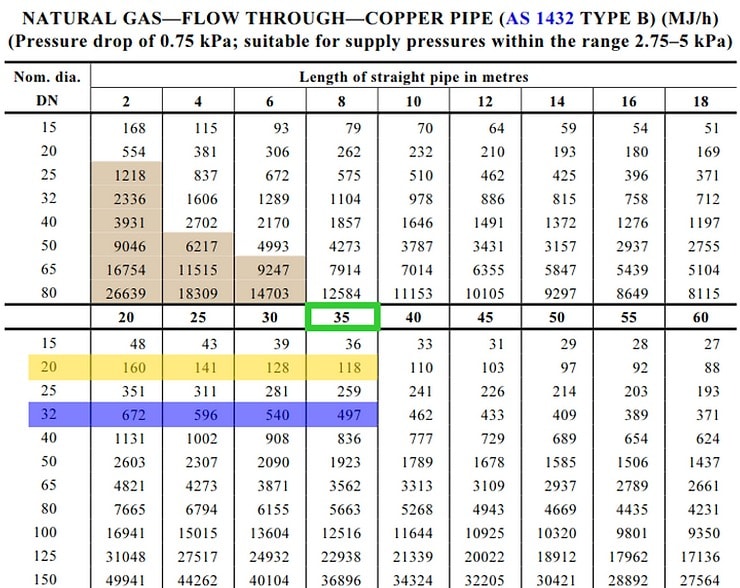
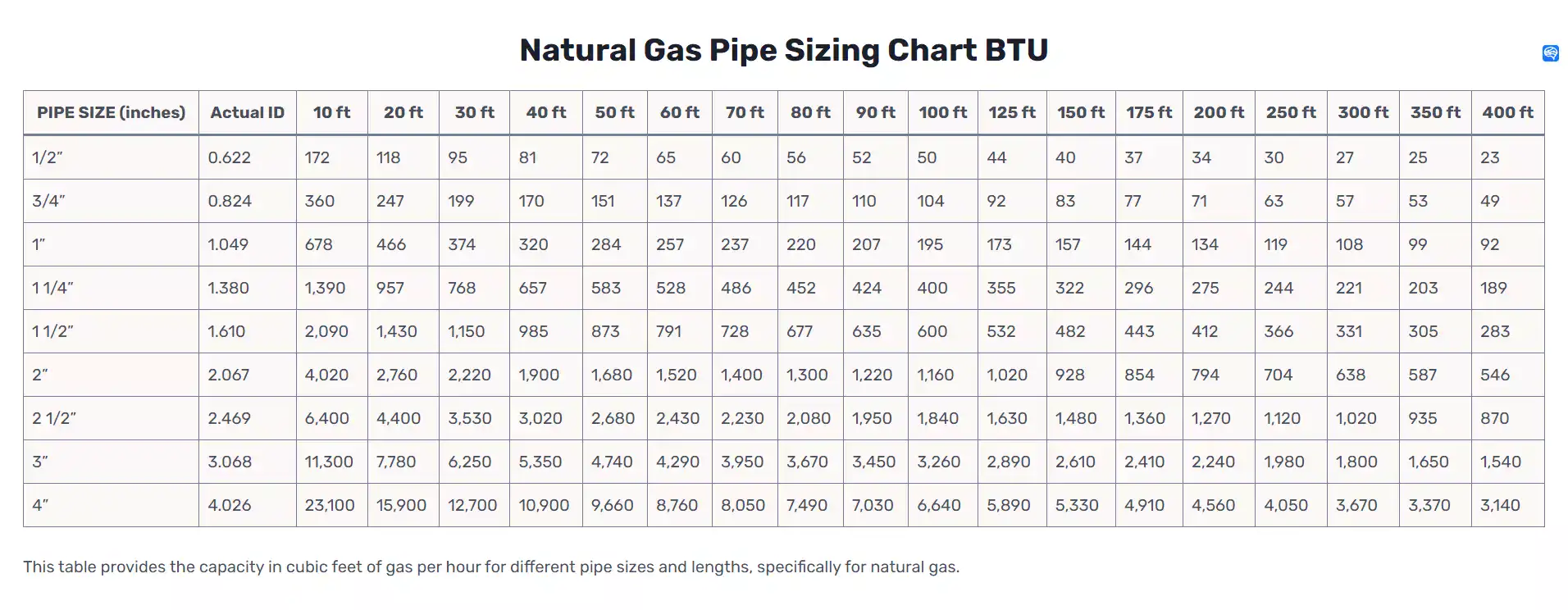
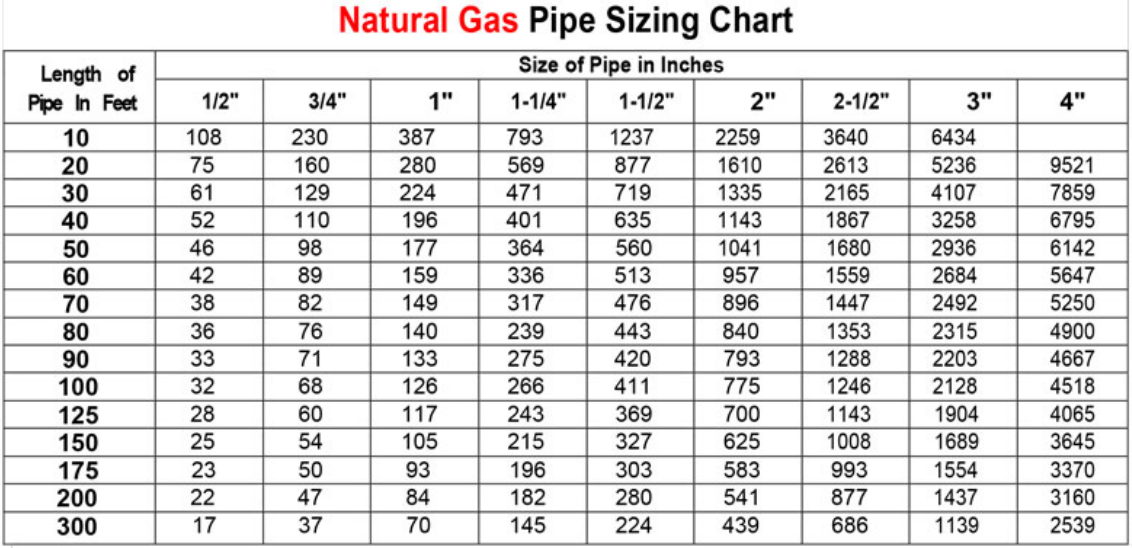
Gas pipe sizing charts are typically found in the International Fuel Gas Code (IFGC) or your local building codes. These charts provide the maximum length of pipe allowed for a given pipe size, appliance BTU/hr demand, and gas pressure.
Here's how to use gas pipe sizing charts:
- Determine Total BTU/hr Demand: Add up the BTU/hr ratings of all appliances connected to the gas line you're sizing.
- Determine Total Equivalent Length: Calculate the total equivalent length of the pipe run, as described earlier, including the actual pipe length and the equivalent length of all fittings.
- Select the Appropriate Chart: Choose the chart that corresponds to your gas pressure (e.g., 7 in. w.c. for natural gas, 11 in. w.c. for propane) and pipe material (e.g., steel, copper, PE).
- Locate the Correct BTU/hr Column: Find the column in the chart that corresponds to the total BTU/hr demand you calculated in Step 1. If your exact BTU/hr value isn't listed, use the next higher value.
- Find the Maximum Length: Look down the selected BTU/hr column until you find a length that is greater than or equal to the total equivalent length you calculated in Step 2.
- Determine the Pipe Size: Read across the row corresponding to the selected length to find the required pipe size. This is the minimum pipe size you should use for that gas line.
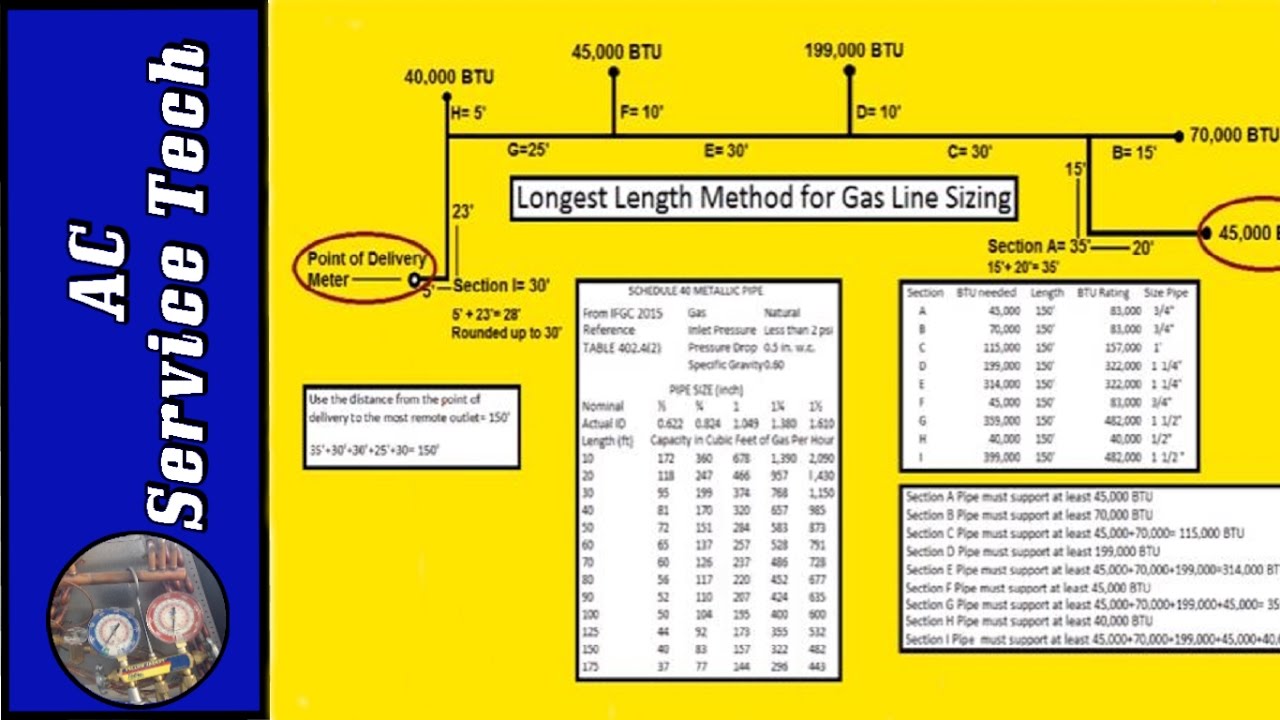
- Account for Multiple Appliances: If the pipe run supplies multiple appliances, be sure to use the cumulative BTU/hr demand of all appliances served by that section of pipe. Start sizing calculations from the furthest appliance and work back to the meter.
Example: Suppose you have a pipe run that is 50 feet long and supplies a furnace with a 100,000 BTU/hr rating. You also have two 90-degree elbows (10 feet equivalent) and one tee (branch) (10 feet equivalent). Total equivalent length is 70 feet. Using a chart for natural gas at 7 in. w.c., you would find the column for 100,000 BTU/hr and look for a length greater than or equal to 70 feet. Let's say the chart shows that a 1-inch pipe can handle 100,000 BTU/hr up to 80 feet. In this case, you would need to use a 1-inch pipe.
Q7: When should I consult a professional for gas pipe sizing?
While this FAQ provides general guidance, there are situations where consulting a qualified plumber or gas technician is highly recommended or even required:
- Complex Systems: If your gas system is complex, with multiple appliances, long pipe runs, or unusual layouts, it's best to consult a professional.
- Uncertainty: If you're unsure about any aspect of the calculation process or the interpretation of the results, seek professional help. It's better to be safe than sorry when dealing with gas systems.
- Code Requirements: Local building codes may require professional design or inspection of gas systems. Always check with your local code officials.
- Modifications: If you're making significant modifications to your gas system, such as adding new appliances or relocating existing ones, a professional can ensure that the modifications are done safely and in compliance with codes.
- Leak Concerns: If you suspect a gas leak, evacuate the area immediately and call your gas company or a qualified technician. Do not attempt to repair the leak yourself.
- Safety First: Gas systems can be dangerous if not installed or maintained properly. If you're not comfortable working with gas, don't attempt to do it yourself. Leave it to the professionals.
- Permits Required: Many jurisdictions require permits for gas line installations and modifications. A professional plumber or gas fitter will be familiar with local permitting requirements and can obtain the necessary permits on your behalf.
In conclusion, accurate gas pipe sizing is essential for safety and efficiency. While online tools and charts can be helpful, consulting with a qualified professional ensures compliance with codes and guarantees the proper and safe operation of your gas system. When in doubt, always seek professional advice.