How To Measure Cfm In A Duct

Understanding CFM: The Key to HVAC System Performance
CFM, or Cubic Feet per Minute, is the standard measurement of airflow in an HVAC system. It represents the volume of air moving through your ductwork every minute. Accurate CFM measurements are crucial for ensuring optimal heating, cooling, and ventilation, whether you're dealing with a residential system, a commercial building, or anything in between. Insufficient airflow can lead to uncomfortable temperatures, increased energy bills, and even equipment failure. Conversely, excessive airflow can also reduce efficiency and create uncomfortable drafts. This guide provides a comprehensive overview of how to measure CFM in a duct, catering to homeowners, HVAC technicians, and facility managers alike.
Why Measuring CFM Matters
Before diving into measurement techniques, let's emphasize the importance of accurate CFM readings. Here's why it's vital:
- System Sizing and Performance: HVAC systems are designed to deliver a specific CFM based on the building's size, insulation, and climate. Measuring CFM ensures the system operates within its intended parameters.
- Troubleshooting Issues: Low CFM can indicate problems like blocked filters, leaky ducts, or a malfunctioning blower motor. Identifying the root cause of airflow issues requires accurate measurements.
- Balancing Airflow: In multi-zone systems, measuring CFM helps ensure each zone receives the correct amount of conditioned air, preventing hot or cold spots.
- Energy Efficiency: Optimizing CFM improves energy efficiency by ensuring the system isn't working harder than necessary.
- Indoor Air Quality: Proper airflow contributes to better indoor air quality by effectively circulating and filtering air.
Methods for Measuring CFM in a Duct
Several methods can be used to measure CFM in a duct, each with varying levels of accuracy and complexity. Here's a look at some common techniques:
1. The Traverse Method (Using a Pitot Tube and Manometer)
The traverse method is considered one of the most accurate ways to measure CFM. It involves taking multiple velocity readings across the duct's cross-section and averaging them to determine the average air velocity. This method requires a pitot tube, a manometer (or differential pressure gauge), and some basic mathematical calculations.
Equipment Required:
- Pitot Tube: A specialized tube that measures both static and total pressure.
- Manometer: Measures the difference between total and static pressure, which is the velocity pressure. Digital manometers are often preferred for their accuracy and ease of use.
- Measuring Tape: For accurately determining the duct dimensions and traverse points.
Procedure:
- Prepare the Duct: Drill small holes (typically ¼ inch) at specific traverse points across the duct. The number of holes depends on the duct's size and shape. For rectangular ducts, use the log-Tchebycheff rule to determine traverse point locations. For round ducts, refer to appropriate charts or software to determine point locations.
- Connect the Pitot Tube: Insert the pitot tube into each hole, ensuring it's facing upstream (against the airflow). Connect the pitot tube to the manometer.
- Record Velocity Pressure: At each traverse point, record the velocity pressure reading from the manometer.
- Calculate Velocity: Use the following formula to calculate air velocity at each point:
Velocity (feet per minute) = 4005 x √Velocity Pressure (inches of water column) - Calculate Average Velocity: Average all the velocity readings.
- Calculate Duct Area: Determine the cross-sectional area of the duct in square feet.
- For rectangular ducts: Area (sq ft) = Width (ft) x Height (ft)
- For round ducts: Area (sq ft) = π x (Radius (ft))^2
- Calculate CFM: Multiply the average velocity by the duct area:
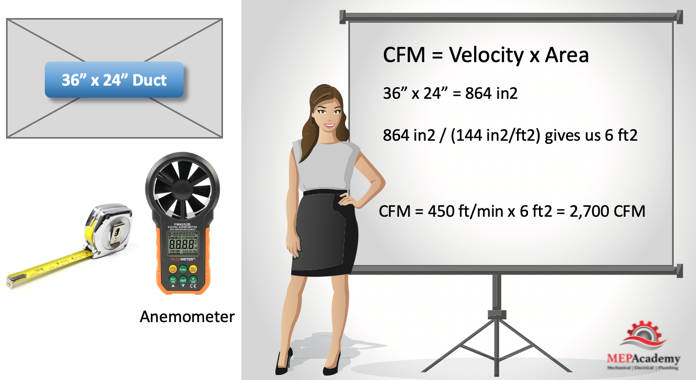
CFM = Average Velocity (feet per minute) x Duct Area (square feet)
Example: Let's say you have a rectangular duct that is 12 inches wide and 8 inches high. After performing a traverse and calculating the average velocity, you find it to be 800 feet per minute.
Duct Width: 12 inches = 1 foot
Duct Height: 8 inches = 0.67 feet
Duct Area = 1 ft x 0.67 ft = 0.67 sq ft
CFM = 800 ft/min x 0.67 sq ft = 536 CFM
2. Using a Vane Anemometer
A vane anemometer (also known as a rotating vane anemometer) is a device that directly measures air velocity. It features a rotating vane that spins proportionally to the airflow. Vane anemometers are relatively easy to use and provide a quick way to estimate CFM, although they are generally less accurate than the traverse method, especially in ducts with turbulent airflow.
Equipment Required:
- Vane Anemometer: Choose an anemometer with a probe size suitable for the duct dimensions.
- Measuring Tape: For determining duct dimensions.
Procedure:
- Measure Duct Area: As described in the traverse method.
- Take Velocity Readings: Hold the vane anemometer in the center of the duct or traverse the duct if possible to get an average reading. Ensure the anemometer is positioned correctly and facing the airflow.
- Calculate CFM: Multiply the average velocity reading from the anemometer by the duct area.
3. Using a Hot-Wire Anemometer
A hot-wire anemometer measures air velocity by sensing the cooling effect of airflow on a heated wire. These anemometers are more sensitive to low air velocities and can be useful in situations where a vane anemometer may not be suitable. However, they can also be more susceptible to errors caused by dust or contaminants in the air.
Equipment Required:
- Hot-Wire Anemometer: Ensure the probe is sized appropriately for the duct.
- Measuring Tape: For determining duct dimensions.
Procedure:
- Measure Duct Area: As described in the traverse method.
- Take Velocity Readings: Insert the hot-wire anemometer probe into the duct and allow it to stabilize. Take multiple readings across the duct if possible, to get a more accurate average.
- Calculate CFM: Multiply the average velocity reading by the duct area.
Factors Affecting CFM Measurements
Several factors can influence the accuracy of CFM measurements. Being aware of these factors and taking steps to mitigate their effects can help ensure more reliable results:
- Turbulent Airflow: Irregular airflow patterns can significantly affect velocity readings. Taking multiple readings and averaging them can help minimize this effect.
- Duct Shape and Size: The shape and size of the duct influence airflow distribution. The traverse method is most accurate when the required number of readings for the given shape and size are taken.
- Equipment Calibration: Ensure your measurement equipment (manometer, anemometer) is properly calibrated.
- Obstructions: Obstructions in the duct, such as dampers or elbows, can disrupt airflow. Take measurements far enough away from obstructions to minimize their impact.
- Duct Leakage: Leaky ducts can lead to inaccurate CFM measurements. Seal any leaks before taking measurements.
Interpreting CFM Readings
Once you've obtained CFM measurements, it's essential to interpret them correctly. Compare your measured CFM values to the design specifications for your HVAC system. If the measured CFM is significantly lower than the design CFM, it could indicate a problem. The rule of thumb is 400 CFM per ton for residential systems. For example, a 3-ton AC system should deliver approximately 1200 CFM.
Here are some possible causes of low CFM:
- Dirty Air Filter: A clogged filter restricts airflow.
- Blocked Ductwork: Obstructions in the ductwork can reduce airflow.
- Leaky Ductwork: Leaks can cause a loss of air pressure and reduce CFM.
- Faulty Blower Motor: A failing blower motor may not be able to deliver the required CFM.
- Undersized Ductwork: Ductwork that is too small for the system's capacity can restrict airflow.
Conclusion
Measuring CFM in a duct is a critical task for ensuring the optimal performance of your HVAC system. By understanding the different measurement methods, factors that can affect accuracy, and how to interpret readings, you can effectively troubleshoot airflow issues, improve energy efficiency, and maintain a comfortable indoor environment. Whether you're a homeowner looking to optimize your home's comfort, an HVAC technician diagnosing a system problem, or a facility manager overseeing a large building, mastering CFM measurement techniques is an invaluable skill.